# Verify and Enforce the Decision
Octet decides and signs. Your backend enforces. This page shows how your backend checks a decision receipt and turns it into what happens to the request.
## Why the backend, not the app
The app gets the decision first, but a user controls their own device. They can change the app, replay an old answer or skip the check. The receipt is signed by the Octet policy engine with a key the device never has, so your backend can tell a real, current decision from anything else.
## 1. Send the receipt with the request
Have the app send `receipt` from the `DecisionResult` together with the request it protects, for example in the body of the order or the sign-up call. A receipt is valid for 5 minutes after the engine signs it, so ask for the decision right before the request.
## 2. Know which decision you expect
The receipt's `decision_ref` identifies the check it answers, and `policy` names the policy that decided it. Your backend checks both, so a permit from another check or another policy can't be sent instead.
Have the app send `decisionRef` with the request, and act on each `decision_ref` for one request only. Together with the checks below, that refuses an old or reused receipt.
If your backend asks the engine again with the same `decision_ref`, the engine decides again from the same proofs and signs a new receipt. Keep the latest receipt for that `decision_ref`, and don't count it as a new check.
Your backend can also start the check itself, so the decision comes to your backend directly and never passes through the app. See [Start the check from your backend](#start-the-check-from-your-backend).
## 3. Verify the receipt
A receipt is a compact JWS signed with Ed25519 (`alg` `EdDSA`, `typ` `octet-decision-receipt+jwt`). The engine's public keys are at:
```
https://gw.octetproof.com/.well-known/decision-receipt-jwks.json
```
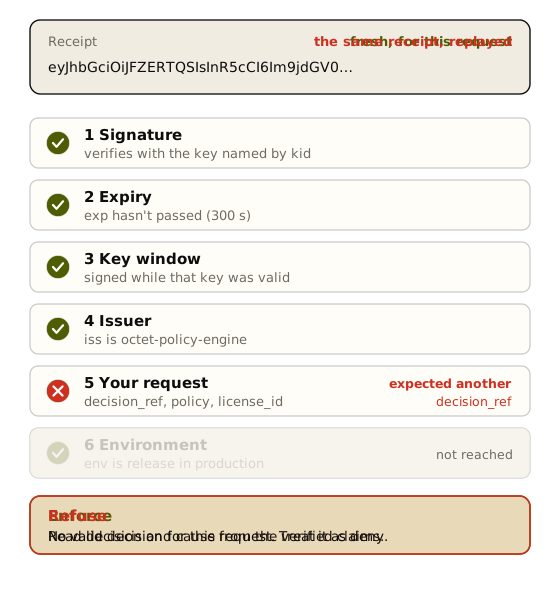
Each key has a `kid`, a `valid_from` and, once it is replaced, a `valid_until`, all in Unix seconds. A receipt is valid when:
1. its signature verifies with the key whose `kid` is in the receipt's header
2. it hasn't expired (`exp`). Skip this check only when you re-check an archived receipt later
3. it was signed inside that key's window. A replaced key still counts for 300 seconds after its `valid_until`
4. `iss` is `octet-policy-engine`
5. `decision_ref` is the one you expected, `policy` is the policy that protects this request (and `policy_version` too, if you pin one), and `license_id` is yours
6. `env` is `release`. A `sandbox` receipt comes from a simulator, an emulator or a debug build. Accept it only in your test environment
{: .docs-anim }
Uses [`jose`](https://github.com/panva/jose).
```javascript
import { decodeProtectedHeader, importJWK, jwtVerify } from "jose";
const JWKS_URL = "https://gw.octetproof.com/.well-known/decision-receipt-jwks.json";
const GRACE_S = 300; // a replaced key still verifies for 5 minutes after valid_until
let jwksCache = null;
async function receiptKey(kid) {
if (!jwksCache || !jwksCache.keys.some((k) => k.kid === kid)) {
jwksCache = await (await fetch(JWKS_URL)).json(); // refetch on an unknown kid
}
const jwk = jwksCache.keys.find((k) => k.kid === kid);
if (!jwk) throw new Error("unknown receipt key");
return jwk;
}
// Returns the receipt's claims, or throws. decisionRef is the one your
// backend expected for this request, policy is the policy that protects it,
// licenseId is your license id.
export async function verifyReceipt(receipt, { decisionRef, policy, licenseId, getKey = receiptKey }) {
const { kid } = decodeProtectedHeader(receipt);
const jwk = await getKey(kid);
const { payload: c } = await jwtVerify(receipt, await importJWK(jwk, "EdDSA"), {
algorithms: ["EdDSA"],
typ: "octet-decision-receipt+jwt",
issuer: "octet-policy-engine",
}); // checks the signature and exp
if (c.iat < jwk.valid_from || (jwk.valid_until && c.iat >= jwk.valid_until + GRACE_S)) {
throw new Error("receipt signed outside its key's window");
}
if (c.decision_ref !== decisionRef) throw new Error("receipt is for another request");
if (c.policy !== policy) throw new Error("receipt is for another policy");
if (c.license_id !== licenseId) throw new Error("receipt is for another license");
if (c.env !== "release") throw new Error("not a release receipt");
return c;
}
// The request may go ahead only on a permit without a cause (a cause means
// UNKNOWN), whose every obligation you fulfilled.
export function mayProceed(claims, fulfil) {
return claims.decision === "permit" && claims.cause == null &&
(claims.obligations ?? []).every(fulfil);
}
```
Uses [PyJWT](https://pyjwt.readthedocs.io/) with the `cryptography` package.
```python
import json
import urllib.request
import jwt # PyJWT, with the cryptography package for EdDSA
JWKS_URL = "https://gw.octetproof.com/.well-known/decision-receipt-jwks.json"
GRACE_S = 300 # a replaced key still verifies for 5 minutes after valid_until
_jwks = None
def receipt_key(kid):
global _jwks
if _jwks is None or not any(k["kid"] == kid for k in _jwks["keys"]):
with urllib.request.urlopen(JWKS_URL) as r: # refetch on an unknown kid
_jwks = json.load(r)
for k in _jwks["keys"]:
if k["kid"] == kid:
return k
raise ValueError("unknown receipt key")
def verify_receipt(receipt, *, decision_ref, policy, license_id, get_key=receipt_key):
"""Returns the receipt's claims, or raises. decision_ref is the one your
backend expected for this request, policy is the policy that protects it,
license_id is your license id."""
header = jwt.get_unverified_header(receipt)
if header.get("typ") != "octet-decision-receipt+jwt":
raise ValueError("not a decision receipt")
jwk = get_key(header.get("kid"))
c = jwt.decode(
receipt,
jwt.PyJWK(jwk, algorithm="EdDSA").key,
algorithms=["EdDSA"],
issuer="octet-policy-engine",
options={"require": ["exp", "iat"]},
) # checks the signature and exp
if c["iat"] < jwk["valid_from"] or (
jwk.get("valid_until") and c["iat"] >= jwk["valid_until"] + GRACE_S
):
raise ValueError("receipt signed outside its key's window")
if c.get("decision_ref") != decision_ref:
raise ValueError("receipt is for another request")
if c.get("policy") != policy:
raise ValueError("receipt is for another policy")
if c.get("license_id") != license_id:
raise ValueError("receipt is for another license")
if c.get("env") != "release":
raise ValueError("not a release receipt")
return c
def may_proceed(claims, fulfil):
"""The request may go ahead only on a permit without a cause (a cause means
UNKNOWN), whose every obligation you fulfilled."""
return (
claims["decision"] == "permit"
and claims.get("cause") is None
and all(fulfil(o) for o in claims.get("obligations", []))
)
```
## 4. Enforce
Decide from the verified claims, and only from them:
| Claims | What it means | What your backend does |
|---|---|---|
| `cause` is present, whatever the `decision` | UNKNOWN: the proofs couldn't settle the location, so the policy used its fail-safe answer | Your choice. Often: ask the user to try again with location on |
| `decision` is `permit`, no `obligations` | The policy's conditions hold | Let the request go ahead |
| `decision` is `permit`, with `obligations` | The policy's conditions hold if you also do something, such as a step-up authentication | Go ahead only once you fulfilled every obligation. Treat one you don't recognise as not fulfilled |
| `decision` is `deny`, no `cause` | A rule or the default decided against the request | Your choice: refuse, review or log it |
| No receipt, or it doesn't verify | No decision | Treat it as `deny` |
`mayProceed` and `may_proceed` above let a request go ahead only on a `permit` with no `cause` and every obligation fulfilled. Everything else is your policy, not Octet's. See [Decision Response](/docs/magistrate/reference/decision/) for `cause` and `obligations`, and how the studio's YES, NO and UNKNOWN map to these claims.
## 5. Keep the receipt
Octet doesn't give you a way to fetch a receipt later, so store each receipt you act on, with the request it decided. It stays checkable against the public key, and `/.well-known/decision-receipt-key-history.json` lists every receipt key the engine has used, so a receipt still verifies after its key is replaced. When you check an archived receipt against the history, check its chain too: entry 0 is signed by its own key, and each later entry by the key before it.
## Start the check from your backend
Instead of calling `decide` in the app, your backend can run the check itself. The app only makes the proofs, and the decision comes back to your backend.
**1. The app asks your backend for a check**, and sends `challengeEnv` with the request. It is `"sandbox"` when the SDK signed in with a sandbox token, and nil or null otherwise.
**2. Your backend asks for a challenge.**
```
POST https://gw.octetproof.com/v1/decide/challenge
{ "policy": "p_...", "env": "sandbox" }
```
Send `"env": "sandbox"` only when the app sent it. Without it, a sandbox build's check looks for production proofs, finds none and comes back UNKNOWN, with `cause` `absence`.
The answer has `decision_ref`, `nonce` and `expires_at`. Keep `decision_ref`, and send `nonce` to the app.
**3. The app makes the proofs for that nonce**, and sends them to your backend with its license ID and its enrolment.
```swift
let env = magistrate.challengeEnv(license: license) // "sandbox" or nil
let nonce = try await api.startCheck(env: env)
let proofs = try await magistrate.prove(license: license, nonce: nonce)
let enrolment = magistrate.attestationEnrolment() // a JSON string, or nil
try await api.submitProofs(licenseId: license.licenseId,
proofs: proofs.compactMap(\.proofBytesBase64URL),
enrolment: enrolment)
```
```kotlin
val env = magistrate.challengeEnv(license) // "sandbox" or null
val nonce = api.startCheck(env)
val proofs = magistrate.prove(license, nonce)
val enrolment = magistrate.attestationEnrolment() // always null on Android
api.submitProofs(licenseId = license.licenseId,
proofs = proofs.mapNotNull { it.proofBytesBase64Url },
enrolment = enrolment)
```
**4. Your backend asks for the decision.**
```
POST https://gw.octetproof.com/v1/decide
{
"policy": "p_...",
"license_id": "...",
"decision_ref": "...",
"proofs": [{ "proof_bytes_b64": "..." }],
"attestation_enrolment": { ... }
}
```
`license_id` is always required: the engine checks the proofs against the apps registered on your license. Send `attestation_enrolment` as a JSON object, the app's string parsed, not as a quoted string. Leave it out when the app sent none.
The answer is a [decision response](/docs/magistrate/reference/decision/) with its receipt. Verify and enforce it as in steps 3 to 5, with the `decision_ref` your backend kept.
**The enrolment on iPhone.** An iPhone's first check needs the enrolment. A proof carries only the device's App Attest assertion, and the engine learns the device's key from the enrolment, once. Without it, a first-time iPhone's check comes back `deny` with a `cause`, which is UNKNOWN. Send it every time: the engine ignores it for a device it already knows. The engine learns the key only from a decide that carries the proofs, as in step 4. A decide without `proofs`, where the engine fetches them itself, ignores `attestation_enrolment`, so an iPhone's first check must carry its proofs. On Android, `attestationEnrolment()` always returns null, because every proof carries its own hardware key chain, so one backend flow serves both. `decide` and `decideMany` send the enrolment for you.